Security Service Operations performance analysis
How can field service performance be optimized through data? This project analyzes technician performance and job complexity to uncover key drivers of efficiency and improve resource allocation.
View the full project code on GitHub →
Overview
Project summary:
- Built a synthetic operational dataset (Python, SQLite)
- Analyzed technician performance & job complexity (SQL)
- Delivered KPI dashboard in Power BI
- Identified key drivers of operational efficiency
This project transforms operational data into actionable insights to improve resource allocation and service efficiency. The goal was to understand how technician skill levels and job complexity influence operational performance, including completion rates, job duration, and delays.
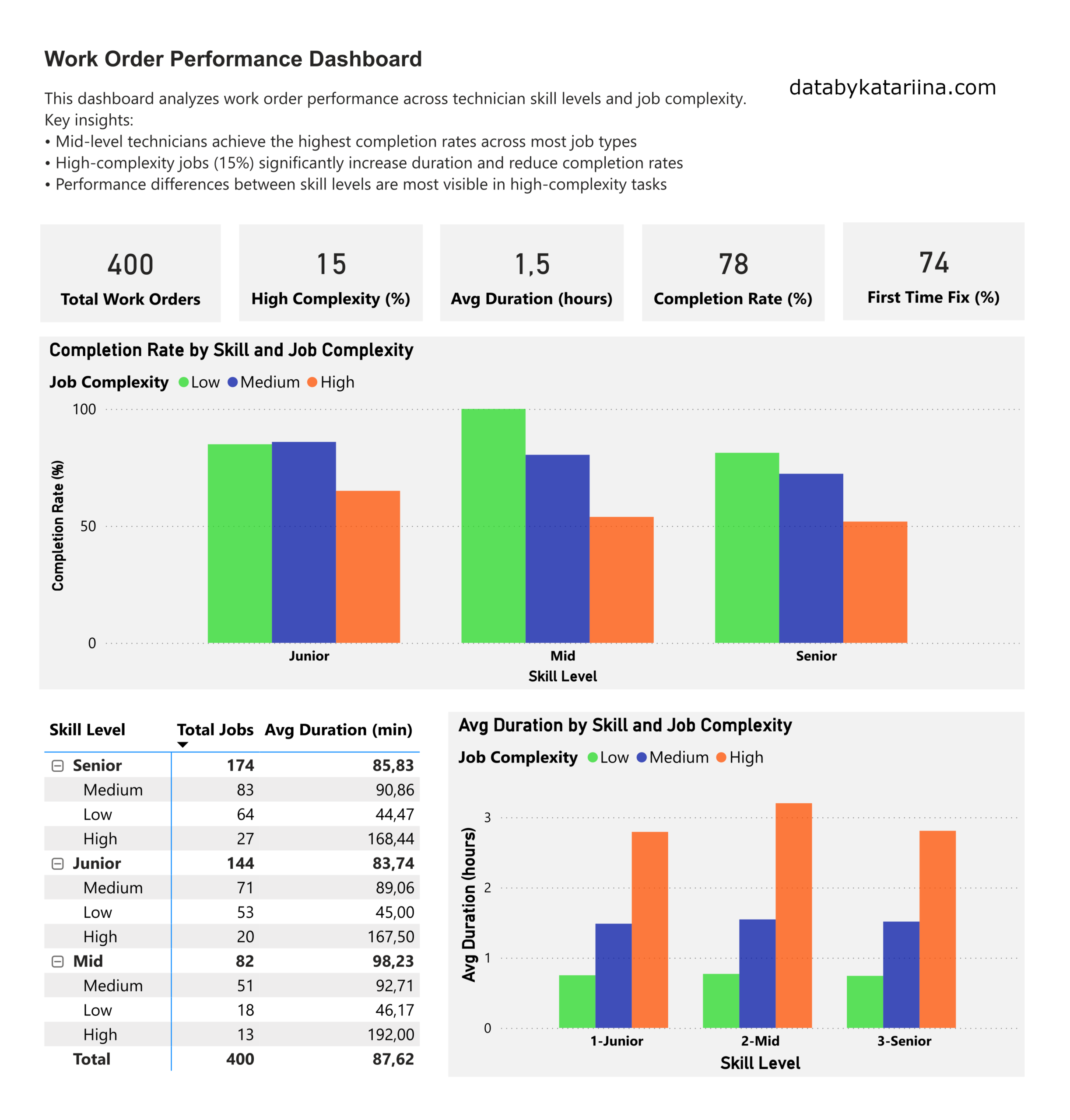
This dashboard highlights key performance patterns across technician skill levels and job complexity impact operational efficiency and performance outcomes.
Key insights of the dashboard:
- Mid-level technicians deliver the highest completion rates
- High-complexity jobs significantly increase duration and reduce outcomes
- Performance gaps are most visible in high-complexity tasks
Business Context
Security service companies rely heavily on efficient field operations to maintain customer satisfaction and profitability. Key operational challenges include:
- Managing varying technician skill levels
- Handling jobs with different levels of complexity
- Minimizing delays and repeat visits
- Ensuring high first-time fix rates
Operational inefficiencies — especially in high-complexity jobs — can lead to increased costs, longer service times, and reduced customer satisfaction. The objective of this project was to simulate these challenges and identify how performance varies across different scenarios, supporting better resource allocation and operational planning.
Analytical approach
This project demonstrates a full analytical workflow:
- Data generation (Python): Created a realistic synthetic dataset including technicians, customers, and work orders with business logic (complexity, delays, performance drivers)
- Data storage (SQLite): Structured data into a relational database for scalable querying
SQL analysis:
- Aggregated performance metrics (completion rate, delay rate, job duration)
- Compared technician performance across skill levels
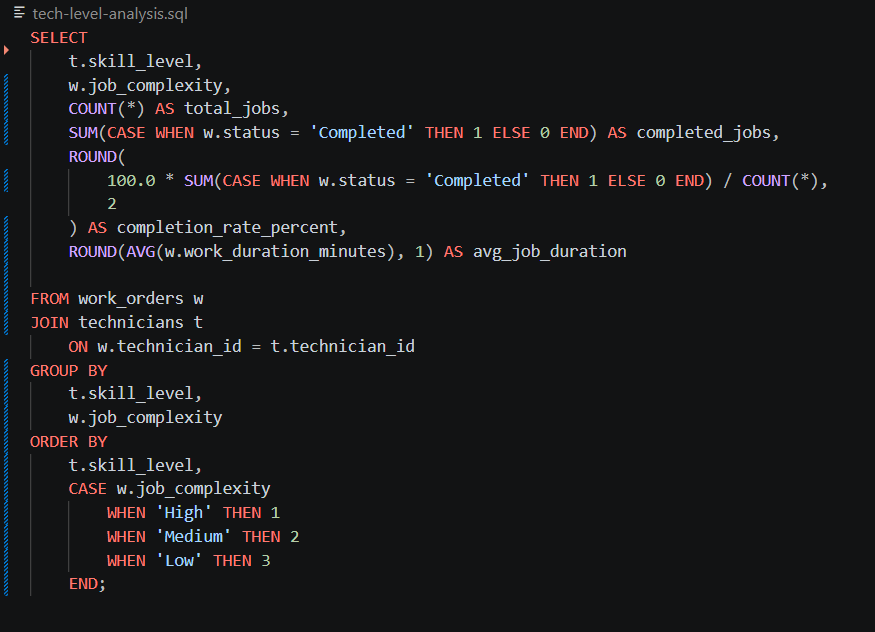
- Analyzed impact of job complexity using JOIN, GROUP BY, and CASE logic
Power BI dashboard:
- Built interactive KPI visuals
- Developed DAX measures for percentage-based metrics
- Designed a clean, executive-level performance view
Strategic Angle
This project emphasizes how operational data can be translated into business value.
Rather than focusing only on technical metrics, the analysis highlights:
- How job complexity impacts efficiency and outcomes
- Where performance gaps exist between technician skill levels
- How delays and longer durations affect overall operations
The approach reflects real-world business analysis, where the goal is not just to measure performance, but to understand its drivers and support decision-making.
Business Impact
The project resulted in a structured performance analysis framework and a dashboard that provides a clear overview of operational efficiency.
- Built a scalable performance analysis framework
- Enabled visibility into key operational drivers
- Identified performance gaps across technician levels
- Designed KPI-based dashboard for decision-making
Technical Implementation:
The analysis was performed using SQL queries to aggregate performance metrics and identify operational patterns across techinician skill levels and job complexity. Example of SQL logic used to calculate performance metrics and completion rates:
Key insights
Mid-level technicians achieve the highest completion rates across most job types.
High-complexity jobs (~15%) significantly increase duration and reduce completion rates.
Performance differences between skill levels are most visible in high-complexity tasks.
Operational efficiency is strongly influenced by job allocation and complexity management.
Overall, the results highlight the importance of aligning technician skill levels with job complexity to improve efficiency and service outcomes.